
How to Scale a Shopify Store Beyond $20K/Month
For a Shopify business with growing demand, operational bottlenecks can become a capacity constraint when founders are still handling recurring customer support, inventory, CRM and administrative work themselves.
Why Your Shopify Store’s $20K/Month Ceiling Isn't a Marketing Problem (It's an Ops Problem)

Every e-commerce founder hits a wall where revenue completely flattens.
You’ve optimized your Shopify theme. Your Klaviyo flows are live. Your ROAS on Meta is decent. Yet, you’ve been stuck between $20K and $50K a month for the last three quarters.
You think you have a marketing problem, so you throw more money at ads or spend late nights tweaking product pages. But the needle doesn't move.
The harsh reality? You don’t have a growth problem. You have a bandwidth problem. You aren't stalled because you lack strategy; you’re stalled because the founder of a scaling business is currently acting as the Head of Customer Support, the Inventory Logistics Coordinator, and the Data Entry Clerk.

When you spend four hours a day fighting fires in Gorgias and manually updating supplier spreadsheets, you have zero hours left for the needle-moving, high-leverage tasks that actually scale a brand.
The Hidden Cost of the "Do It Myself" Trap
Most founders look at outsourcing admin work purely as an expense. They think,"I can save $500 a month by just handling customer returns and tag management myself."
This is broken math. Here is the true cost of your time:
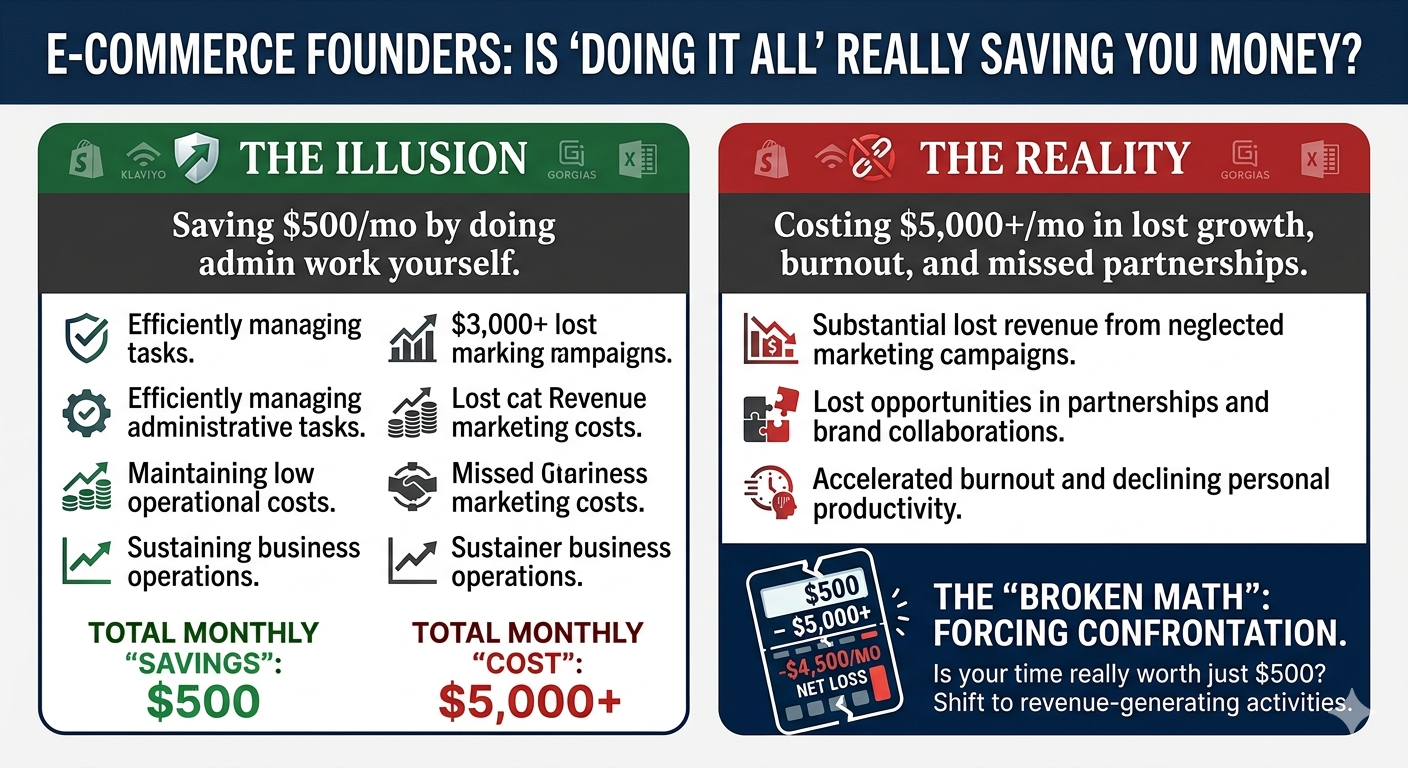
The Opportunity Cost: Every hour you spend copy-pasting tracking numbers or editing a Shopify description is an hour you didn't spend negotiating bulk manufacturing rates, securing wholesale partnerships, or engineering your next big product launch.
The Burnout Tax: Growth requires strategic clarity. If you are cognitively exhausted by 11:00 AM from answering “Where is my order?” tickets, your decision-making for the rest of the day is compromised.
To scale past $50K/month, you must transition from a reactive operator to a proactive CEO. And that requires finding a scalable virtual assistant service for business owners.
Why Traditional Outsourcing Breaks E-Commerce Brands
When founders finally realize they need help, they usually take one of two paths—both of which frequently fail:
1. The Freelance Marketplace Roulette (Upwork /OnlineJobs.ph)
You hire a general virtual assistant for $5/hour. It sounds great on day one. By day ten, you realize you have to spend 20 hours filming Loom videos, writing SOPs from scratch, and explaining how Shopify tags work.
The result: You’ve accidentally taken on a second full-time job as a corporate trainer. The moment they make a mistake or disappear, you pull the plug and say, "It's just easier if I do it myself."
2. The Legacy Managed Agency
You hire a massive, traditional agency that charges $30 to $50/hour to protect you from the management headache.
The result: Your margins disappear. You’re paying U.S. corporate prices for administrative tasks, erasing the exact cost-efficiency that outsourcing was supposed to provide.
The AI-First Operational Framework
The modern way to scale a Shopify store isn't just about hiring random freelancers; it’s about deploying an integrated operational engine.
Imagine a system where your operations scale seamlessly without your direct involvement:
Pre-Trained E-Commerce Experts: Your team shouldn't need a tutorial on how to handle an exchange in Gorgias, update an email segment in Klaviyo, or track a project in Notion. They should know the stack on Day 1.
AI-Augmented Workflows: A modern administrative assistant doesn't just type manually; they use AI tools to draft customer responses 5x faster, synthesize data into weekly KPI reports, and flag inventory anomalies before they stock out.
Autonomous Accountability: You shouldn't have to audit clock-in times or verify if tasks were completed. A dedicated quality-assurance and account management structure should handle the oversight, giving you clean data and completed tasks every Friday.
Remove Yourself from the Daily Grind
If your brand is generating over $20K/month and you are still personally touching more than two operational tools a day, you are bottlenecking your own growth.
You built your business for freedom and scale, not to become an employee of your own Shopify dashboard. It’s time to hand off the day-to-day admin to a managed, pre-trained team that executes flawlessly while you focus entirely on your macro strategy.
How We Solve This For You
You shouldn't have to build these automated engines or train team members from scratch. At Xecutely, we step in to handle your day-to-day operations flawlessly so you can step back into the CEO role.
Ready to uncover the bottlenecks keeping you stuck? Claim your Free 20-Minute Operations Audit with Xecutely. We will evaluate your current tech stack, isolate your text or scheduling leaks, and map out a custom plan to give you back 40+ hours a week.
Get a Free Call with Our Team
Direct answers
Scaling beyond $20K/month
When ops—not ads—limits growth, what to delegate first, how VAs and AI fit, and how to measure delegation ROI. Links to Xecutely e-commerce use cases and client pricing.
Is operational bandwidth the real Shopify scaling bottleneck?
Often yes when revenue grows but founder hours stay flat on support, fulfillment admin, inventory updates, and inbox work—before adding more ad spend. Compare time logs to revenue per founder hour.
What recurring work creates the biggest founder time drain?
Customer support tickets, order exceptions, CRM hygiene, supplier follow-ups, and reporting loops—see e-commerce VA tasks for examples.
Which e-commerce tasks should be delegated first?
High-volume, documented workflows: inbox/tickets, order tracking, listing updates, and standard reports—not pricing strategy or brand positioning.
How can a VA improve operational capacity?
A managed VA adds dedicated hours on your Shopify stack with onboarding and oversight—see client plans and how Xecutely manages VAs.
What does an AI-augmented operations workflow look like?
AI drafts replies, summarizes tickets, or fills templates; a VA reviews, applies judgment, and executes in Shopify, Gorgias, or your CRM—human-in-the-loop for exceptions.
How should founders measure delegation ROI?
Baseline founder hours on ops tasks, then track hours recovered, error rates, response times, and capacity for growth work after delegation—avoid absolute causal claims without your own data.
Frequently asked questions
How do I know whether operations are limiting growth?
Track founder time spent on repeatable admin, customer support, CRM, inventory and reporting work and compare it with higher-value growth activities.
What should I delegate first?
Start with repeatable, well-scoped tasks that consume meaningful time and do not require the founder’s unique strategic judgment.
Can AI replace an e-commerce VA?
AI and VAs can complement each other; the correct mix depends on workflow complexity, risk, tools and the level of human judgment required.
How should I measure delegation ROI?
Measure time recovered, quality/accuracy, throughput, avoided hiring/management work, and downstream business capacity using a documented baseline.