
How to Hire an E-Commerce Virtual Assistant for a Shopify Business
The safest way to hire an e-commerce VA is to define the recurring work first, vet for the exact tools and workflows required, control access permissions, and use a clear onboarding process with measurable responsibilities.
The Shopify Founder’s Guide to Hiring a VA
(Without Losing Your Mind or Margin)
You’ve made it. Your Shopify store is generating consistent revenue, your ads are converting, and you finally have a validated product.
Then reality hits. Instead of focusing on growth, you are spending your Monday mornings managing inventory discrepancies, your Tuesday afternoons copy-pasting tracking numbers, and your evenings answering “Where is my order?” tickets in Gorgias.
You need help. But for an e-commerce founder, hiring your first Virtual Assistant (VA) feels like a massive risk. You worry about data security, the hours it will take to train them, and whether they’ll make a mistake that tanks your customer review score.
The truth is, hiring a great e-commerce VA isn't about luck. It’s about running a strict, predictable process. Here is the operational framework to source, vet, and onboard a high-performing e-commerce VA without the administrative headache.
1. Map Your Operational Bottlenecks First
Never hire a VA to "help run the store." That is too vague, and vague hiring criteria often lead to misaligned expectations. Before you write a job description, look at your weekly routine and isolate the specific, repetitive tasks that don't require your unique strategic mind.
For a scaling Shopify brand, these usually fall into three distinct buckets:
Front-End Customer Experience: Managing live chat, processing returns/exchanges, handling email tickets, and responding to social media comments.
Back-Office Inventory & Logistics: Updating supplier spreadsheets, tracking production milestones, flagging low-stock alerts, and updating product variants.
Marketing Operations Support: Setting up basic email segmentation rules, scheduling social posts, uploading creative assets, and updating landing page copy.
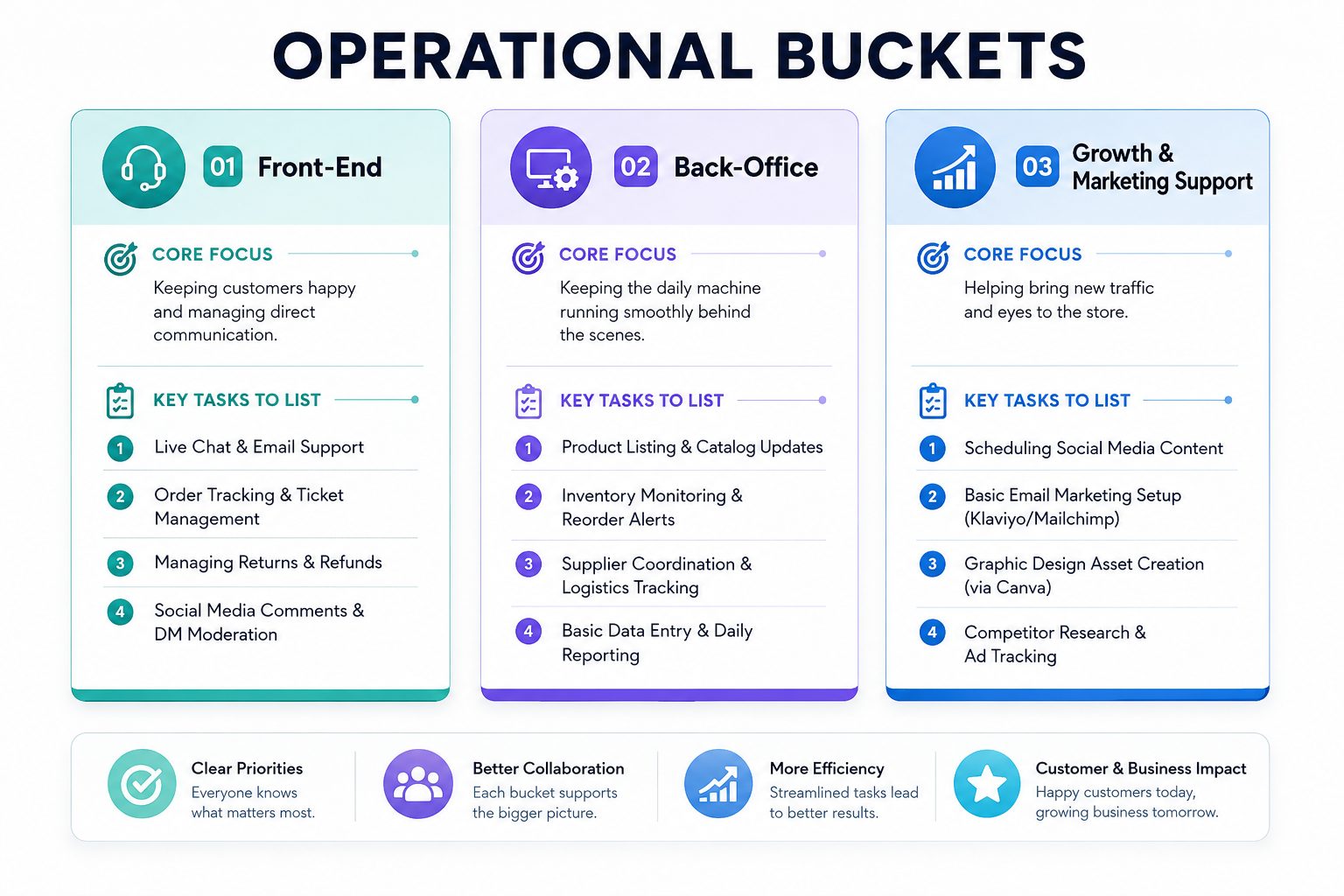
Mapping out your business into these three pillars helps prevent overlap, streamlines onboarding, and ensures your remote team is focused on high-leverage tasks.
Pick one bucket to hand off first. Do not hire one person and expect them to launch TikTok ads, write copy, and fix liquid code all on day one. Start with clear, structural administrative boundaries.
2. Source from the Right Talent Ecosystem
Where you look determines who you find. If you throw a generic job post onto a massive, unvetted freelancer marketplace, you will get flooded with hundreds of generic resumes within hours—forcing you to spend your weekend filtering through noise.
The standard marketplace route requires a heavy operational tax from you:
The Keyword Filter: You have to manually filter out candidates who don’t explicitly list your exact tech stack (e.g., Shopify, Klaviyo, Asana).
The Loom Test: You have to build custom video screening challenges just to verify if they can follow basic directions.
The Culture Check: You have to handle all background and reference checking yourself.
To scale fast, you need a talent pipeline that is already oriented around the modern e-commerce stack.
3. Vet for Technical Competency, Not Just "Years of Experience"

A resume that says "5 years of e-commerce experience" means nothing if those five years were spent on an outdated platform. In e-commerce, execution speed is everything. You need to test for platform familiarity.
During the vetting phase, look for concrete proof of these specific skill sets:
Core Skill Areas to Test During Vetting
1. Shopify & Store Dashboard Mastery
What They Must Know: Managing daily order queues, issuing partial/full refunds, updating inventory tags, and editing basic product details or variants.
Why It Matters: Preventable fulfillment delays and order processing errors melt away when your VA intimately understands your store's back-end.
2. Customer Support Tech Stack
What They Must Know: Setting up Gorgias, Zendesk, or Help Scout macros; managing tracking loops; and executing proper tag assignments.
Why It Matters: It keeps your customer response times under 2 hours without sacrificing the human touch.
3. Operations & Asynchronous Hubs
What They Must Know: Navigating workspace tools like Notion, Asana, ClickUp, and Slack.
Why It Matters: Ensures your VA can communicate asynchronously and execute daily workflows without missing vital tasks.
4. Mitigate Your Security Risks On Day 1
The biggest fear founders have when bringing an assistant into their store is security exposure. You do not have to hand over your primary password or expose your banking details to delegate successfully.
Protect your business by enforcing these three strict rules:
Never Share Master Passwords: Use a secure credential manager like Bitwarden or 1Password to share access to tools without ever revealing the actual text password.
Enforce Staff Account Scoping: Create a distinct staff account within Shopify, Klaviyo, and your customer service platform. Explicitly restrict their permissions. They should only see what they need to execute their job—no direct access to export customer lists or modify financial settings.

Restricting permissions and using password managers protects your store’s data while empowering your VA to work independently. Use a Dedicated Workspace: Ensure all team communication happens inside dedicated company channels (like Slack or structured Notion spaces) rather than personal messaging apps.
The Alternative: Skip the Hiring and Training Grind
Hiring, training, and managing a remote VA is a full-time job. For an e-commerce founder trying to push past a revenue ceiling, spending 30 hours building training academies and auditing daily KPI reports is a massive diversion of focus.
That is why we built Xecutely.
We don't match you with random freelancers and leave you to figure out the rest. We provide U.S. e-commerce businesses with pre-trained, fully managed virtual assistants who already know Shopify, Klaviyo, Gorgias, and Notion before their very first day. Our internal operational team handles the training, quality assurance, and weekly KPI reporting for you—giving you total leverage without the management headache.
Why Shopify Store Owners Partner with Xecutely
Scaling a Shopify brand requires more than just extra hands—it requires a reliable, integrated operational engine.
Xecutely platform provides highly skilled, pre-vetted virtual assistants who arrive fully trained in the modern e-commerce ecosystem, including Shopify, Gorgias, Klaviyo, Slack, and Notion. From day one, they hit the ground running with zero training friction.
To ensure seamless execution, every engagement is backed by our internal quality assurance, active performance monitoring, and ongoing operational oversight. We handle the management, systems, and consistency, allowing you to confidently step away from daily administrative bottlenecks.
Whether you need to streamline customer support, optimize order processing, coordinate inventory, or secure your back-office administration, our team integrates seamlessly as a dedicated extension of your business. This frees you to focus entirely on what matters most: revenue growth, customer acquisition, and strategic scale.
The Strategic Impact of Executive Leverage
The velocity of a brand’s growth is directly tied to where its founder spends their energy. When scaling past a certain revenue ceiling, continuing to invest your highest-value hours into daily administrative loops isn't just inefficient—it is an expensive opportunity cost.
True operational scale happens when routine execution is decoupled from the founder’s personal bandwidth. By shifting mission-critical but repetitive operational swimlanes—such as complex customer retention loops, multi-channel inventory synchronization, and back-office logistics—to a specialized team, business owners unlock immediate capacity.
The return on this leverage is immediate:
Compounded Growth: Reclaimed capital and time are instantly redirected into high-leverage initiatives like supply chain optimization, aggressive marketing acquisition, and strategic partnership development.
Institutional Stability: Your back-office transforms from a reactive bottleneck into a proactive, structured asset that runs seamlessly in the background.
Accelerated Execution: Customer experience metrics improve and fulfillment friction disappears because dedicated specialists are owning the outcomes, not a distracted founder.
Frequently Asked Questions
How much does it cost to hire a virtual assistant for an e-commerce business?
Is it better to hire a freelancer or use a managed VA service?
Ready to Step Out of the Operational Weeds?
Let’s look at your current workload and see what you can safely take off your plate this week. Get a clear look at how an AI-augmented, fully managed team can stabilize your back-office operations so you can focus entirely on scaling.
Click Here to Book Your Free Strategy Call & Find Your Perfect VA
Direct answers
Hiring an e-commerce VA for Shopify
Fastest paths to hire, what to delegate first, skills and vetting, store access, onboarding, and when managed support fits. Links to Xecutely e-commerce use cases and client pricing.
What is the fastest way to hire an e-commerce VA?
Fastest with a defined task list: use a managed provider with pre-trained VAs on your stack, or post a narrow role on a marketplace and screen for Shopify tool experience. Xecutely targets client setup within 3 business days after contract—see How It Works.
What should I delegate first in a Shopify business?
Start with high-volume, documented work: inbox and tickets, order status, basic listing updates, and CRM hygiene—not pricing, positioning, or vendor negotiations. Examples on e-commerce use cases.
What skills should an e-commerce VA have?
Shopify admin, your support stack (e.g. Gorgias or inbox tools), spreadsheets or CRM, clear written English, and follow-through on SOPs—plus willingness to learn your exact workflows.
How should I vet an e-commerce VA?
Use a paid trial or test task on real scenarios (refund, tracking update, tag hygiene). Check references, tool screenshots, time-zone overlap, and communication clarity—not only résumé keywords.
How should a Shopify business protect access and data?
Create Shopify staff accounts with least privilege, avoid sharing the owner login, use a password manager, enable MFA where available, and document who can change payouts or apps.
What should onboarding look like?
Week-one playbook: tool access, 5–10 SOPs, sample tickets, escalation rules, and daily check-ins—then expand scope as accuracy holds. Managed onboarding is outlined on How It Works.
When should a Shopify founder use a managed VA service?
When you want to skip recruiting, training, and daily QA—especially past ~10 hours/week of repeatable ops. Compare managed plans vs hiring and supervising a freelancer yourself.
Frequently asked questions
How much does it cost to hire an e-commerce VA?
Cost varies by market, skill, geography, hours, management, and training. Compare those dimensions rather than price alone. Xecutely client plans start at US$460/month for 80 hours—see Pricing for list tiers.
What tasks can an e-commerce VA handle?
Common examples include customer support, order processing, inventory administration, CRM/data work, and marketing operations—scoped to your SOPs and tools.
How long does onboarding take?
It depends on hiring model and workflow complexity. For Xecutely managed clients, setup targets 3 business days after contract signing, including discovery, matching, and onboarding—not a universal market guarantee.
How do I protect store data?
Use scoped staff accounts, least-privilege permissions, and a secure credential manager rather than sharing master credentials.
Should I hire a freelancer or use managed support?
The answer depends on how much recruiting, training, QA, and management responsibility the business wants to keep internally. Managed services bundle oversight; freelancers shift that work to the founder.